ALaCarte.Direct
Every day, hundreds of people in Lyon — locals and tourists alike — type "brasserie georges menu" into Google. They want to know the dishes, the prices, the lunch deals — before even stepping through the door at 30, Cours de Verdun Perrache. This query, along with variations like "brasserie georges lyon menu prices", generates significant search volume: several thousand monthly impressions. Yet most restaurants — including century-old institutions — let this traffic slip through their fingers, simply because their online menu isn't properly structured or optimised for search. The result? TripAdvisor, TheFork, or a food blog captures the click instead, inserting itself between the restaurateur and their future customer.
This isn't unique to Brasserie Georges. It applies to every independent restaurateur who hasn't yet realised that their online menu has become their most powerful customer acquisition tool. Let's look at how a legendary Lyon institution illustrates this phenomenon — and more importantly, how you can leverage it for your own establishment.
The Brasserie Georges menu: why this query attracts so many searches
Brasserie Georges, founded in 1836, is one of the largest brasseries in Europe. Its history, its Art Deco interior, its house-made choucroute, and its seafood platters make it a must-visit for anyone travelling to Lyon. But what interests us here is the digital behaviour of its potential customers.
A revealing cluster of search queries
Search Console data reveals a typical pattern around queries related to a well-known restaurant's menu:
- "brasserie georges menu" — the most direct query, typed by customers who already know the restaurant and want to browse the menu before booking
- "brasserie georges" — a branded query, often followed by a refinement towards prices or the menu
- "brasserie georges lyon menu prices" — the quintessential transactional query, asked by someone comparing options for lunch or dinner
Together, these three queries accumulate several thousand impressions. They reveal a clear customer journey: I know the restaurant (or someone recommended it to me), I want to see what they serve and how much it costs, then I decide whether to book.
What the searcher is actually looking for
When someone types "brasserie georges menu", they're not looking for a Wikipedia article about the restaurant's history. They want:
- The list of dishes currently on offer
- Up-to-date prices
- Lunch and dinner set menus
- Special menus (holidays, group dining, events)
- Photos of the dishes, ideally
- A way to book directly
If your website doesn't provide this information in a clear, fast, and mobile-friendly way, the searcher will go looking elsewhere. And "elsewhere" means the intermediary platforms that have perfected the art of structuring this information for Google.
Why restaurants lose control of their own online menu
The paradox is striking: the restaurateur is the only person who knows their menu inside out — and yet it's third-party websites that rank best for queries related to it. How did we get here?
The PDF menu: the most common mistake
The majority of restaurants with a website publish their menu as a downloadable PDF. It's the easiest solution to implement, but it's also the worst from an SEO perspective:
- Google can't properly read PDFs embedded in iframes or hosted as downloads. The content isn't indexed like standard HTML text.
- The mobile experience is dreadful. Pinching to zoom, scrolling horizontally, waiting for a heavy file to load — all of this drives visitors away.
- The PDF is never up to date. Changing a dish or a price means regenerating the file, re-uploading it, and checking the link. In practice, most restaurateurs don't do this often enough.
- No structured data can be associated with a PDF. Google can't extract prices, ingredients, or allergens to display in rich results.
No dedicated menu page
Some restaurants simply don't have a dedicated page for their menu on their website. The menu might appear on the homepage, mixed in with opening hours, the address, and reviews. Or it's buried in a secondary tab with no clean URL.
Without a dedicated page with a clear URL (for example /menu or /our-menu), Google has nothing to index specifically for menu-related queries. The search engine can't match the searcher's intent ("I want to see the menu") with a specific page on your site.
Platforms fill the gap
TheFork, TripAdvisor, Google Maps, Yelp, and local food blogs have figured this out. They create dedicated, structured, optimised pages featuring menus, prices, and reviews. These pages rank for your own branded queries. Every click that goes to these platforms instead of your website is a customer you welcome — but at the cost of a commission or a lost direct relationship.
For an establishment like Brasserie Georges, whose reputation naturally generates search volume, this represents a significant missed opportunity. For a lesser-known independent restaurant, it's wasted visibility.
How a well-optimised digital menu transforms a restaurant's visibility
Let's get practical. What happens when a restaurant properly structures its online menu? The benefits are measurable and quick to materialise.
Capturing "menu + restaurant name" queries
As soon as your menu is published in HTML on a dedicated page of your website, with the right markup (H1 title, subheadings by category, prices as text), Google indexes it and naturally ranks it for queries related to your menu.
For a neighbourhood restaurant, this might represent a few dozen searches per month. For an institution like Brasserie Georges, it's several thousand potential visitors redirected to the restaurant's own website rather than a third-party platform.
The technical elements that make the difference:
- A dedicated, permanent URL for the menu page
- HTML text (not images or PDFs) for every dish and every price
- Structured data markup (Schema.org types
MenuandMenuItem) that enables Google to display rich results - Regular updates that signal to Google the page is active and reliable
- Fast loading times, especially on mobile
Answering the "prices" intent directly
The query "brasserie georges lyon menu prices" is explicitly transactional. The searcher is in decision-making mode. They're comparing, evaluating their budget. If your website clearly displays prices — lunch set menu at one price, tasting menu at another — you're answering their need directly.
This kind of transparency has a dual benefit:
- SEO: Google favours pages that precisely match search intent. Displaying prices helps you rank better for these queries.
- Conversion: a customer who sees the prices before arriving won't be caught off guard by the bill. They come with clear expectations, which reduces dissatisfaction and negative reviews.
Winning position zero and rich results
When your menu is properly marked up with structured data, Google can display your dishes and prices directly in search results as "rich snippets". This is the holy grail of local SEO: your restaurant appears with its key information before the searcher even clicks.
For restaurants that implement these best practices, results are often visible within a few weeks. The menu page climbs in the rankings, click-through rates increase, and website traffic grows at the expense of intermediary platforms.
Case study: what Brasserie Georges teaches us about digital menus
Let's step back and analyse what the Brasserie Georges case reveals for every independent restaurateur.
Reputation alone isn't enough without a structured digital presence
Brasserie Georges enjoys considerable name recognition. Yet queries related to its menu are partly captured by third-party sites. This proves an essential point: even a famous restaurant can't rely solely on its reputation. Its digital presence must be actively managed, structured, and optimised.
If this is true for a nearly two-century-old institution, it's even more true for a neighbourhood bistro or a newly opened restaurant without an established reputation. Your online menu is often the first — and sometimes the only — contact a potential customer will have with your establishment before deciding where to eat.
Search volume is an indicator of real demand
The thousands of impressions on "brasserie georges menu" queries aren't a statistical artefact. They represent real people with a real need: to know what they're going to eat and how much it will cost. Every impression that doesn't convert into a click to your own website is a missed opportunity.
For your restaurant, even if the volume is more modest, the principle is the same. Type "menu + [your restaurant name]" into Google. What do you see? Your website in first position, or a TheFork listing? The answer will tell you whether or not you control your online presence.
Seasonality amplifies the effect
Restaurants like Brasserie Georges, which offer seasonal menus or event-specific dishes (New Year's Eve, Valentine's Day, Mother's Day), see search spikes during these periods. If your menu isn't updated to reflect these changes, you miss out on these peaks.
A digital menu that you can modify in minutes — adding the Christmas menu in November, removing the summer menu in October — lets you capture these seasonal searches without any particular technical effort.
Practical guide: structuring your digital menu for local SEO
Here are the concrete steps to turn your menu into an effective SEO tool. You don't need to be a web developer to implement them.
Step 1: Create a dedicated menu page on your website
Your menu deserves its own page, with a clean, stable URL. Not a PDF, not an image, not a section on the homepage. A proper HTML page with:
- A clear title: "Our Menu" or "Menu & Prices"
- Sub-sections by category: starters, mains, desserts, set menus, drinks
- Prices as text, not images
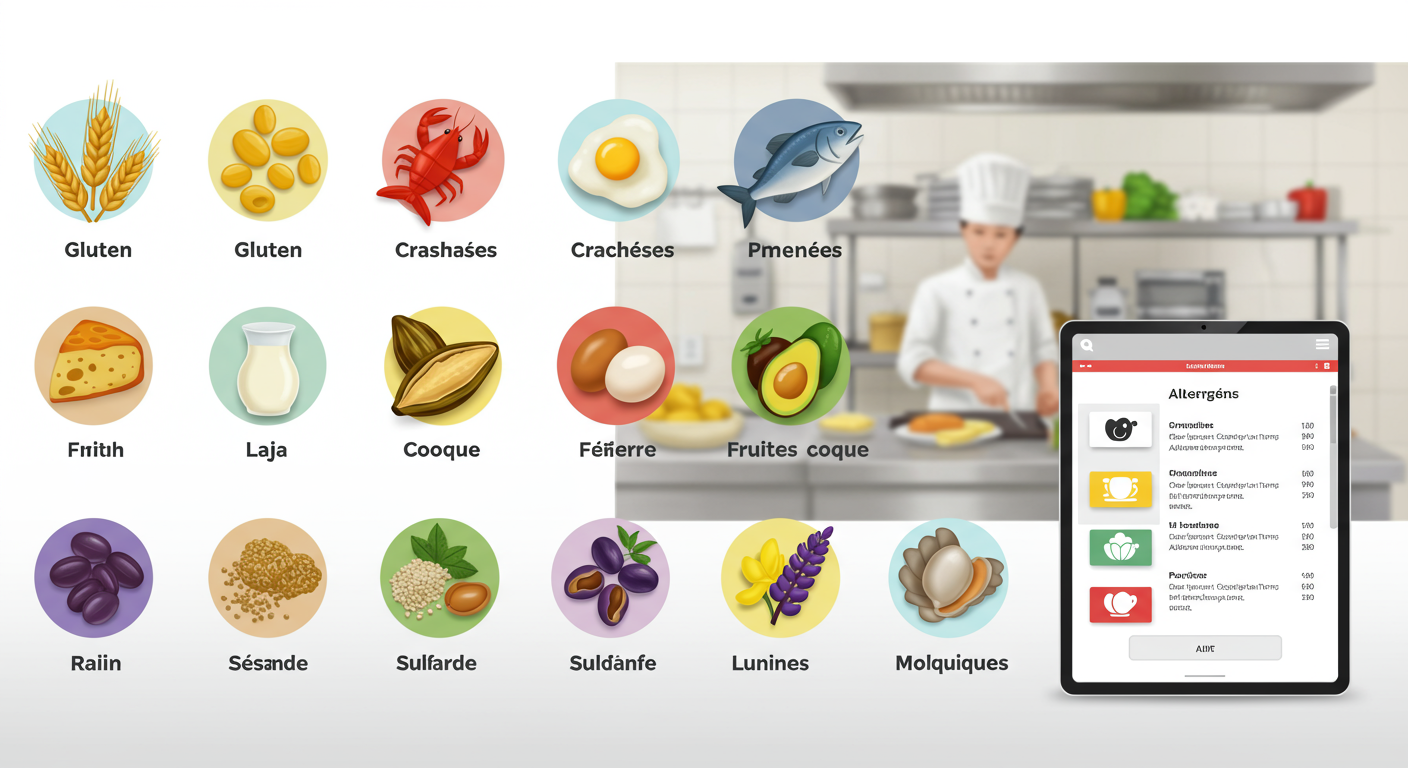
- Allergen and nutritional information if available
Step 2: Structure the content for Google
Each dish category should be a subheading (H2 or H3). Each dish should appear as text, with its name, a short description, and its price. This structure allows Google to understand exactly what your menu contains.
Example structure:
-
H2: Starters
- Salade Lyonnaise — Smoked lardons, poached egg, garlic croutons — £12
- Country terrine — Cornichons, toasted bread — £9
-
H2: Main Courses
- Quenelle de brochet with sauce Nantua — Pilaf rice — £19
- Andouillette AAAAA — Wholegrain mustard, hand-cut chips — £16
This structure is readable for the customer AND for Google. Everyone wins.
Step 3: Add structured data
Structured data (Schema.org) consists of invisible markup that is essential for Google. It helps the search engine understand that your page contains a restaurant menu, with dishes and prices.
If you use a CMS like WordPress, plugins are available to add this markup without coding. If you use a specialist restaurant platform like ALaCarte.direct, structured data is generated automatically when you publish your menu online.
Step 4: Optimise for mobile
Over 70% of local searches are made on smartphones. Your menu page must be perfectly readable on a phone screen — no zooming, no horizontal scrolling, with buttons large enough to tap with a finger.
Test your menu page on your own phone. If you have to pinch to zoom to read a price, the experience isn't up to standard. Loading speed is also critical: a page that takes more than 3 seconds to display loses the majority of its mobile visitors.
Step 5: Update regularly
A static menu that never changes sends a negative signal to Google: this page may no longer be current. Conversely, a menu that evolves regularly — new seasonal dishes, price adjustments, chef's specials — is perceived as an active and trustworthy page.
Ideally, you should be able to update your menu in a few clicks, without going through a web agency. This is one of the advantages of a digital menu managed through a dedicated platform: you retain full control over the content, with no technical dependency.
Mistakes to avoid when digitising your menu
Digitising your menu isn't complicated, but certain mistakes crop up frequently. Here are the most common pitfalls.
Publishing your menu as an image
Some restaurateurs take a photo of their paper menu and publish it on their website or Instagram. It's better than nothing, but from an SEO perspective, it's almost as bad as a PDF. Google can't read text within images. Your menu becomes invisible to search engines.
Not displaying prices
Some restaurateurs hesitate to publish their prices online, fearing comparison with competitors or wanting to preserve an element of surprise. This is a strategic mistake for two reasons:
- Customers are searching for prices. The query "brasserie georges lyon menu prices" is direct proof. Failing to meet this demand means losing those visitors.
- Transparency builds trust. A restaurant that displays its prices online shows it has nothing to hide. This reassures customers, especially those discovering you for the first time.
Forgetting your Google Business Profile
Your online menu must be consistent with the information on your Google Business Profile (formerly Google My Business). If your profile shows a set menu at £15 but your website says £19, you lose credibility. Keep your information in sync.
Google allows you to add your menu directly to your business listing. Take advantage of this: it's an additional signal for local search rankings.
Neglecting dish-specific reviews
Customer reviews that mention specific dishes strengthen your rankings for those terms. Encourage satisfied customers to mention what they ate in their Google reviews. "The quenelle de brochet was exceptional" is far more useful for your SEO than a simple "Great restaurant".
This ties into best practices for managing your online reputation and protecting your customer data, a topic that deserves attention as soon as you start collecting reviews or booking information.
Beyond the menu: building a complete digital strategy for your restaurant
The digital menu is the starting point, not the final destination. Once your menu is properly optimised for search, you can expand your digital strategy.
Create content around your menu
Every new dish, every seasonal menu, every chef's special can become content for your website or social media. This content strengthens your search rankings and keeps your audience engaged.
For example, a blog post about your New Year's Eve menu, published in November, will capture searches from people planning their evening. If you offer private events or wedding and reception packages, a dedicated page with the corresponding special menus will attract high-value, qualified traffic.
Leverage gift cards linked to your menu
Your signature dishes can become the basis for gift cards with optimised pricing to maximise your sales. A "tasting menu for two" sold as a gift card, visible on your website, is both a product and an SEO asset.
Train your team on the digital dimension
Your front-of-house team is your first digital ambassador. Encourage them to direct satisfied customers towards your website and Google reviews. Every mention of a dish in a customer review strengthens your menu's search rankings.
The culinary team-building events you organise can also become content for your website, with their own menus and pricing, broadening your search footprint.
Track your results
Set up Google Search Console (free) on your website and monitor the queries driving traffic to your menu page. You'll see which terms searchers are using, how often your page appears in results, and what your click-through rate is.
This data is invaluable for refining your strategy: if you notice many people searching for "brunch + [your restaurant]" and you don't have a brunch page, create one. If "group menu" is generating impressions, publish your group dining offers.
What the Brasserie Georges numbers mean for your restaurant
You're not Brasserie Georges, and that's precisely what makes this analysis relevant to you. If an institution with historic name recognition benefits from optimising its digital menu, an independent restaurant without that recognition needs it even more.
Proportional impact
Brasserie Georges generates thousands of impressions because its brand is well known. Your restaurant may generate a few dozen or a few hundred. But the mechanism is identical: every impression converted into a click to your own website is a customer you welcome without an intermediary, without a commission, with a direct relationship.
On a volume of 50 monthly searches for "menu + [your restaurant]", capturing 30 clicks to your site instead of 5 means 25 additional potential customers per month arriving without going through TheFork. Over a year, that's 300 more direct contacts.
The cost of inaction
Doing nothing means letting intermediary platforms answer on your restaurant's behalf. Every month without an optimised digital menu is a month where you're paying commissions on customers who could have come directly. It's also a month where your competitor who has structured their menu online gains visibility at your expense.
Regulatory compliance is another aspect not to overlook. Displaying your menu online exposes you to certain obligations, particularly regarding food safety and traceability, which are better anticipated than discovered during an inspection.
The investment is minimal
Structuring your menu online requires neither an advertising budget nor advanced technical skills. It's about publishing text — your dishes, your prices, your descriptions — in a structured format on your website. The return on investment in terms of search rankings is almost immediate.
If you don't have a website or your current site doesn't allow you to easily publish a structured menu, solutions like ALaCarte.direct let you create an SEO-optimised digital menu in minutes, complete with structured data and instant updates.
Conclusion: your menu is your best online salesperson
The lesson from Brasserie Georges is clear: even Lyon's most renowned restaurant needs a structured digital menu to capture customers searching for it online. For an independent restaurateur, this need is even more pressing.
Here's what you can do today:
- Type "menu + [your restaurant name]" into Google. Does your website appear first? If not, you have a problem to solve.
- Check your current menu page. Is it in HTML with prices as text? Or is it a PDF, an image, or nothing at all?
- Create or restructure your menu page following the steps outlined in this article: dedicated page, HTML text, displayed prices, structured data, mobile optimisation.
- Update your menu every time a dish changes. Content freshness is a quality signal for Google.
- Set up Google Search Console and monitor queries related to your menu. Adapt your content based on what your customers are actually searching for.
The "brasserie georges menu" query generates thousands of searches because customers want to know what they're going to eat before they arrive. Your customers do exactly the same with your restaurant. The only question is: is it your website answering them, or an intermediary's?
The answer to that question determines who controls the relationship with your customers. And in an industry where margins are tight and customer loyalty is everything, that control is priceless.