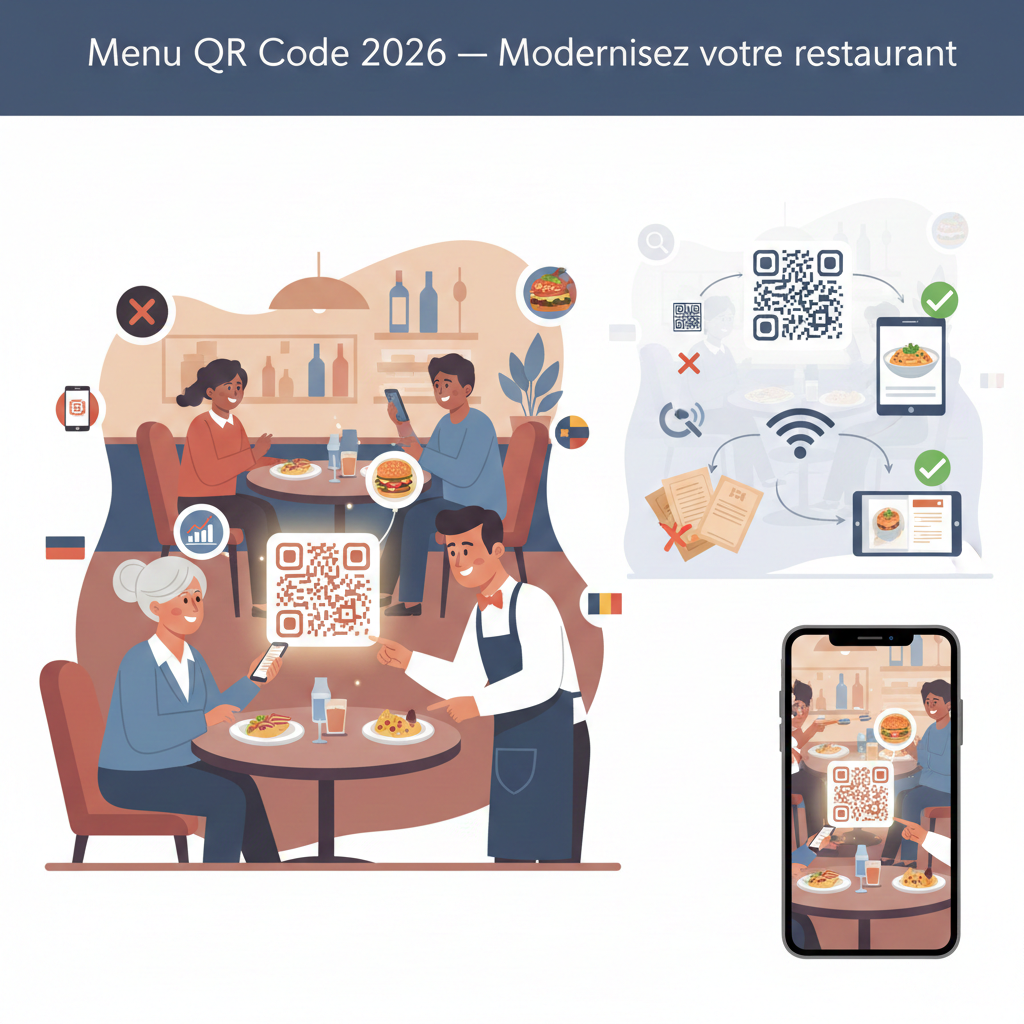
The QR code menu has become essential in modern dining. But between the massive post-Covid adoption and the quiet abandonment by some, how do you ensure your QR code is actually used by your customers? This comprehensive guide gives you all the keys to a successful implementation.
Why the QR Code Menu Is Still Relevant in 2026
Contrary to pessimistic predictions, the digital menu via QR code didn't die with the end of health restrictions. The numbers speak for themselves:
- 67% of consumers prefer scanning a QR code over handling a physical menu (NRA Study 2025)
- +23% adoption compared to 2023 among 18-35 year-olds
- Average savings of £2,000/$2,500 per year on printing for a 50-cover restaurant
What's changed? Restaurateurs who succeed with QR codes no longer treat them as a health requirement, but as a genuine customer experience tool.
The 10 Mistakes That Are Killing Your QR Code Menu
Before we look at best practices, let's identify the fatal mistakes that lead customers to ignore your QR code.
Mistake #1: The invisible QR code
A 2cm QR code tucked in the corner of the table, printed in grey on a beige background... Nobody sees it. Solution: Minimum 4cm x 4cm, high contrast, central position.
Mistake #2: No accessible WiFi
Your customer on data roaming won't bother scanning. Solution: Display the WiFi code next to the QR code or ensure good 4G coverage.
Mistake #3: A PDF menu to download
The customer scans and lands on a 15 MB PDF that's not mobile-friendly. Guaranteed frustration. Solution: Responsive web menu, loading time under 3 seconds.
Mistake #4: No help for older customers
20% of your clientele doesn't know how to scan a QR code. Solution: Train your staff to offer assistance + keep paper menus as a backup.
Mistake #5: A menu that's never updated
Last week's daily special is still showing. Solution: Daily or real-time update process.
Mistake #6: Zero explanation
Just a QR code with no text. The customer has no idea what they'll find. Solution: Add "Scan to view our menu" + a smartphone icon.
Mistake #7: A broken link
The QR code leads to a 404 page. Disaster. Solution: Test your QR code every week.
Mistake #8: Too many QR codes everywhere
WiFi, menu, Google reviews, Instagram... The customer doesn't know which one to scan. Solution: One main QR code prominently displayed, the rest kept small.
Mistake #9: Amateur design
A QR code printed on a laminated A4 sheet. A brand image disaster. Solution: Invest in quality display stands.
Mistake #10: No call-to-action
The customer has no incentive to scan. Solution: "Discover today's specials by scanning" or "See dish photos here".
The Best Displays for Your QR Code
The display makes all the difference. Here are the options ranked by effectiveness:
Table-top (Highest scan rate)
| Display | Indicative price | Advantages | Disadvantages |
|---|---|---|---|
| Table tent | £2-7/$2-8 per unit | Highly visible, stable, professional | Can clutter small tables |
| Acrylic cube | £4-13/$5-15 per unit | Modern design, QR visible on all sides | Higher price point |
| Engraved coaster | £3-9/$3-10 per unit | Discreet, functional | Can be hidden by the glass |
| Table sticker | £0.50-2/$0.50-2 per unit | Economical, permanent | Wears out, less elegant |
Entrance / Reception area
- Roll-up banner: Ideal for larger venues, highly visible (£40-130/$50-150)
- Framed A3/A4 poster: Affordable and effective (£8-25/$10-30)
- Digital screen: Modern, allows animations (£170/$200+)
Innovative displays for 2026
- NFC-enabled QR code: The customer simply taps their phone — no scanning needed
- Illuminated QR code: Lights up in dim ambiance
- Table projection: QR code projected onto the tablecloth (premium venues)
How to Introduce the QR Code to Your Customers
Staff training is crucial. Here's the recommended script:
"Hello! Our menu is available by scanning this QR code with your phone. You'll find dish photos and the chef's recommendations. If you'd prefer a printed menu, no problem at all — I'll bring one right over!"
Key points:
- Offer, never impose
- Highlight the content (photos, recommendations) rather than the practical aspect
- Alternative always available for customers who prefer it
- Assist without condescension those who need help
ROI Calculation: What You Actually Save
Here's a concrete calculation for a 60-cover-per-day restaurant:
Direct savings (annual)
| Menu printing (4 changes/year) | -£1,000/$1,200 |
| Replacing damaged menus | -£350/$400 |
| Update time (5h/month → 30min) | -£700/$800 (time value) |
| Total savings | £2,000/$2,400 per year |
Indirect gains
- +8% average spend thanks to dish photos (Cornell Study 2024)
- +15% dessert orders when photos are visible
- -12% order-taking time (customers decide faster)
Initial investment
Quality QR code displays: £80-250/$100-300 for 20 tables
Professional digital menu subscription: £0-25/$0-30/month depending on the solution
ROI: 6-8 months maximum
Case Study: Le Grand Café Fauchon, Paris
The prestigious Grand Café Fauchon, located on Place de la Madeleine in Paris, adopted the QR code menu with ALaCarte.Direct back in 2020.
"The solution fits perfectly with our constant pursuit of excellence. Our guests appreciate the modernity and convenience of the digital menu."
Results after 6 months:
- 78% of guests use the QR code
- Complete elimination of paper menus
- Daily updates of recommendations
Checklist Before Launching Your QR Code Menu
✅ Launch checklist
- ☐ Digital menu created and tested on mobile
- ☐ Loading time under 3 seconds
- ☐ Dish photos added (minimum 5)
- ☐ QR code tested on 3 different smartphones
- ☐ Quality display stands ordered
- ☐ Staff trained on how to present it
- ☐ Paper menu alternative available
- ☐ WiFi accessible or 4G coverage confirmed
- ☐ Update process defined
- ☐ Weekly testing scheduled
FAQ: Common Questions About QR Code Menus
Is a QR code menu mandatory in restaurants?
No, QR code menus are not mandatory. They were widely adopted during Covid restrictions but are now a strategic choice for restaurateurs looking to enhance the customer experience and reduce printing costs.
How much does a QR code menu system cost?
Solutions range from free (such as ALaCarte.Direct's basic version) to £25-40/$30-50 per month for premium options. Physical display stands represent a £80-250/$100-300 investment to equip a 20-table restaurant.
How do I create a QR code for my restaurant menu?
The simplest method: create your digital menu on a platform like ALaCarte.Direct, then automatically generate your custom QR code. You can then download it for printing or ordering display stands.
Can older customers use QR code menus?
Around 75% of over-60s know how to use a QR code as of 2025. For the rest, always keep printed menus available and train your staff to offer help with patience and warmth.
Conclusion: The QR Code as a Competitive Advantage
In 2026, the QR code menu is no longer a health requirement but a genuine competitive differentiator. Restaurants that use it smartly win on every front: cost savings, customer experience, and a modern image.
The keys to success:
- Quality: Invest in professional display stands
- Training: Your staff are the first ambassadors
- Content: A rich digital menu (photos, descriptions, recommendations)
- Alternative: Never force the customer
Ready to digitise your menu? Create your free QR code menu in 30 seconds with ALaCarte.Direct.