ALaCarte.Direct
Introduction
Acquiring a new customer costs 5 to 7 times more than retaining an existing one. It's a figure every restaurateur has heard... yet so many overlook it in their day-to-day strategy.
And yet, the reality is stark: a loyal customer spends on average 67% more than a new one, visits 3 to 4 times a year (compared to just once for a casual diner), and becomes your best — and free — brand ambassador.
Too many restaurateurs pour all their energy into acquisition (Facebook ads, aggressive promotions, discount voucher sites...) while completely neglecting retention. For more on this, here's how to turn one-time visitors into regulars after Valentine's Day.
The result? Customers who come once, redeem a deal, then vanish. A constant stream of new faces... but no stability, no community, no lasting profitability. For further reading, understand what your customers truly expect from a restaurant in 2026.
Customer loyalty isn't a "nice-to-have" reserved for fine dining. It's essential for EVERY restaurant, from your neighbourhood pizzeria to a contemporary bistrot.
In this article, you'll discover 8 practical, actionable strategies to turn occasional diners into loyal regulars. No vague theory. Just real-world, tried-and-tested tactics.
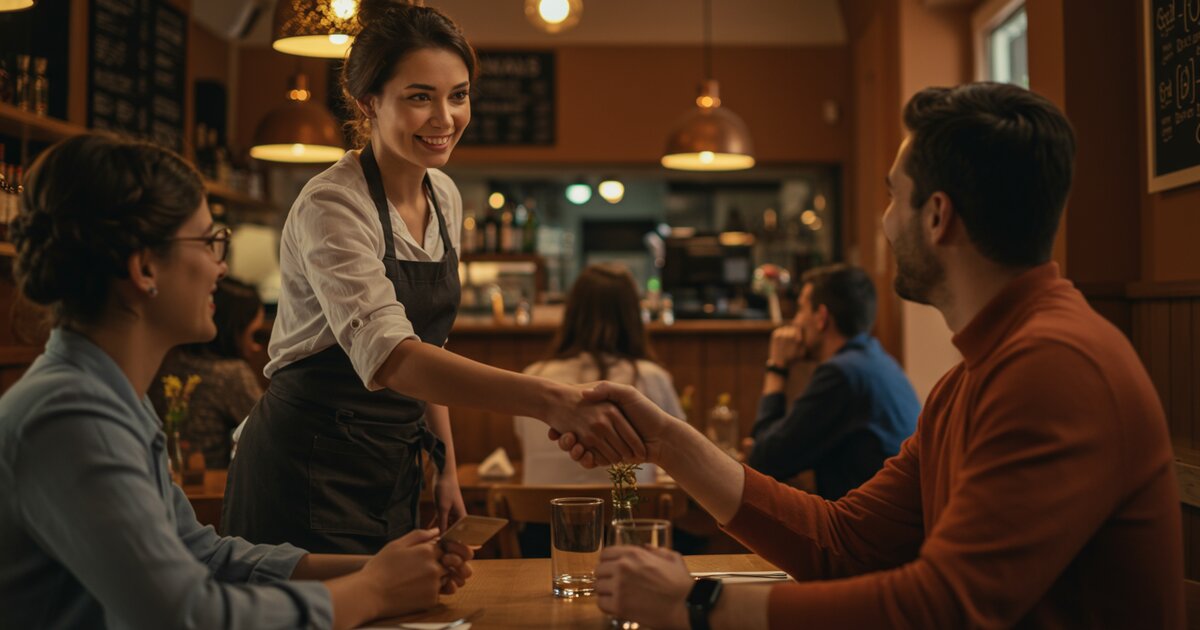
1. The Welcome: First Impressions Are Everything
Why it's critical
A customer forms an opinion about your restaurant within the first 30 seconds of walking in. Before they've even seen the menu. Before they've tasted a single dish. For more on this, avoid these 5 mistakes that drive customers away before they even step inside.
If the welcome is cold, distant, or disorganised → they won't come back, no matter how good your food is or how creative your menu. For further reading, digitalising your restaurant makes it easier to set up modern loyalty programmes.
Conversely, a warm welcome creates a positive first impression that colours THE ENTIRE experience that follows. The customer will be more forgiving, more relaxed, more generous (tips, Google reviews...).
How to nail your welcome
The 3 golden rules:
- Smile and eye contact: Look the customer in the eye, smile genuinely. A forced smile is obvious. A missing one even more so. Train your team to make this second nature.
- Responsiveness: Greet customers within 15 seconds of arrival. Even if it's just to say "Hello, I'll be right with you!" The worst thing? Ignoring a customer standing at the door.
- Personalisation: "Hello! How many are you today?" (smile, eye contact) instead of a flat, mechanical "Hello."
Bonus for returning customers: "Ah, lovely to see you again Mr Johnson! Your usual table is free if you'd like it?"
→ Immediate effect: The customer feels recognised, valued, welcome. They're going to have a great time. And they'll be back.
Common mistake
Letting the welcome slip during busy periods. "We're rushed off our feet, we haven't got time to be friendly."
Wrong. Busy periods are PRECISELY when the welcome matters most. A customer who waits 5 minutes with a smile and a "Sorry for the wait, we'll have you seated in just a moment" will be FAR more patient than a customer who's ignored.
2. The Small Gesture That Changes Everything
The power of the "little extra"
Customers rarely remember the exact dish they had 3 weeks later. They remember how they felt.
An unexpected small gesture creates a positive emotion → memorability → loyalty.
Daniel Kahneman (Nobel Prize in Economics) calls this the "peak-end rule": we remember an experience by its most intense moment (peak) and its ending (end). Create a positive emotional peak → you create a lasting memory.
Real-world examples that work
- A complimentary coffee after the meal: "This one's on the house — thanks for coming!" (cost: £0.25/$0.30, impact: huge)
- A surprise amuse-bouche at the start of the meal: "The chef would like to offer you this little starter while you wait"
- A petit four with the bill: a small chocolate, a homemade biscuit...
- A homemade digestif for regulars: limoncello, infused rum...
- A personalised note on the bill: "Thanks Marie, see you soon! — The team at The Bistrot"
- A loaned umbrella on a rainy day: "Keep it, bring it back next time!" (virtually guarantees a return visit)
Cost: £0.50 to £2 per customer
Impact: Huge (memorability x10, positive word-of-mouth)
Pro tip
Vary your small gestures. If you ALWAYS offer a free coffee, it becomes expected (no surprise = no emotion). Mix it up: one day the coffee, another day a petit four, another day nothing (but an extra-special welcome).
3. Create a Loyalty Card (But Keep It Simple)
The classic mistake: overly complicated programmes
"Buy 10 meals from the Classic menu, earn 15 points, convert to credit at a rate of 1 point = £0.50, but only on Tuesdays and Thursdays excluding bank holidays..."
→ Nobody understands it. Nobody uses it. It fails.
The golden rule for an effective loyalty card: SIMPLICITY. An 8-year-old should be able to understand the system in 10 seconds.
Recommended system
Paper version (old school but effective):
- "1 meal = 1 stamp"
- "10 stamps = 1 free main course OR 1 free dessert"
Digital version (modern and trackable):
- QR code to scan at each visit
- Automatic tracking via an app or website
- Automatic notification when the reward is unlocked: "Well done Sophie, you've unlocked your free dessert! Valid until 31 March."
Free or low-cost tools: Google Forms + an Excel tracking sheet, or a dedicated app like Stamp Me, LoyaltyLion, or even Instagram DMs (for smaller establishments).
Why it works
- Clarity: "Just 3 more visits and I get my free dessert" → instant motivation
- Gamification: A sense of progress (8/10, nearly there!)
- The commitment effect: The closer you get to the reward, the more you want to go back (fear of "losing" your stamps)
Mistakes to avoid
- Expiry too soon: "Valid for 3 months" → frustrating if the customer only visits 4 times a year. Better: 1 year minimum.
- Disappointing reward: 10 visits for a free coffee → the customer feels short-changed. Be generous.
- Forgetting to stamp: If the server forgets to stamp the card, the customer gets frustrated. Train your team.
4. Collect Contact Details (and Use Them Wisely)
Why it's crucial
If you don't collect your customers' contact details, you can't reach out to them. You're entirely dependent on their goodwill (and their memory) to come back.
With their details: you can follow up, offer personalised deals, and maintain the connection between visits.
Restaurants that systematically collect emails and phone numbers see a 40% higher return rate than those that don't.
How to collect (without being intrusive)
Ideal moment: At the time of booking (phone, website) or when signing up for the loyalty card.
Effective wording:
- "Would you like to receive our special offers and news by email/SMS?" (clear opt-in)
- Or via the loyalty card: "Leave us your email to receive your digital loyalty card and never lose your points"
Incentive: "Leave us your email and get 10% off your next visit"
Data protection: ALWAYS ask for explicit consent, and offer an easy unsubscribe option (link at the bottom of every email). Otherwise = fines + angry customers.
How to use this data (without spamming)
Frequency: 1 email or SMS per month MAXIMUM. More = spam = unsubscribes.
Content to send:
- New seasonal menu (with a mouth-watering photo)
- Birthday special offer: "Happy birthday Sophie! We'd love to treat you to a free dessert if you visit this month 🎂"
- Exclusive event: "Tasting evening for our loyal customers on 15 March — limited places"
- Weekly specials (if relevant)
- Win-back for lapsed customers: "It's been 3 months since we last saw you... We miss you! Here's 15% off to welcome you back"
Golden rule: Provide VALUE (useful info, exclusive offers, news). Not just "come to our restaurant". Otherwise = spam = unsubscribes.
5. Personalise the Relationship (Even on a Small Scale)
Customers want to feel unique
A customer who feels like "just a table number" won't come back. A customer who feels recognised, appreciated, treated as an individual → they return AND tell others about it.
Personalisation is the secret weapon of independent restaurants against the chains. McDonald's will NEVER know your name. You can.
Practical steps (even with 100 customers a week)
Note preferences in a notebook or basic CRM:
- "Mr Thompson: window table, still water, never has bread"
- "Mrs Clarke: strict vegetarian, nut allergy"
- "Paul: always brings his dog (water bowl + treat)"
- "Sophie: loves chocolate desserts, birthday on 12 May"
Where to record it: Paper notebook (old school but effective), shared Excel file, or a simple CRM like Notion, Airtable, or even Google Sheets.
Use this information strategically:
- "Hello Mr Thompson! Your usual window table is ready, and I've put a bottle of still water on ice for you."
- "Mrs Clarke, the chef has created a new vegetarian dish today — shall I tell you about it?"
- "Hi Paul! I've got a water bowl ready for your dog, and we've got some treats too if he'd like 😊"
→ The customer feels special. They come back. And they tell their friends.
The "Cheers" effect
You know the TV show "Cheers"? The bar where "everybody knows your name". That's the goal. Make your regulars feel at home.
A restaurateur told us: "We have 40 regulars we know by first name. They account for 60% of our revenue. No advertising needed. They come back every week."
6. Master the After-Visit Experience (Yes, Even in a Restaurant)
The mistake: thinking the relationship ends at the door
The customer has paid → they've left → you forget them → they forget you.
Wrong. The post-visit period is a key moment to make a lasting impression and encourage return visits.
Simple post-visit actions
Day 1 after a first visit:
- Short SMS or email: "Thanks for choosing [Restaurant Name] last night! We hope to see you again soon. If you enjoyed it, we'd love a Google review 😊"
Customer's birthday (if you have their date of birth):
- "Happy birthday Sophie! We'd love to treat you to a dessert if you pop in this month 🎂 Book your table here: [link]"
After an incident (disappointing dish, excessive wait, order mix-up...):
- Personalised email the next day: "Hello Mrs Johnson, I'm sorry about the excessive wait last Friday. That's not acceptable, and we've identified the issue in the kitchen. As an apology, here's a £15 voucher for your next visit. I hope to see you again soon. — Paul, Manager"
→ The magic effect: Turning a disappointed customer (who was about to leave a 1-star Google review) into an ambassador ("They really made it right after the hiccup — I'd recommend them!"). For more on this, master how to handle negative Google reviews in 5 steps.
Tools to automate (without losing the human touch)
- Mailchimp (free up to 500 contacts): automate day-1 and birthday emails
- Google Sheets + Zapier: trigger an automatic SMS after each booking
- Or simply: a reminder in your calendar to send 5 manual texts a day to new customers
7. Create Exclusive Events for Your Loyal Customers
Why it works
Loyal customers love feeling part of a "VIP club". Offering exclusivity = strengthening emotional attachment.
A customer who feels privileged becomes an ambassador. They'll tell everyone ("I was at this private evening at X, it was incredible").
Exclusive event ideas (on a modest budget)
- Private evening for your top 30–50 customers: Tasting of the new menu, meet the chef, complimentary cocktail. Cost: £250–400/$300–500, impact: huge.
- Sneak preview: "Try our new signature dish before anyone else and give us your feedback" (email invitation to your top 100 customers)
- Recurring preferential rate: "Every Tuesday, 15% off for loyalty card holders" (builds loyalty + fills quiet evenings)
- Cooking workshop led by the chef: 15–20 places, priority booking for loyal customers. Price: £35–40/$40–50 per person (covers costs + builds connection)
- Wine & cheese tasting: Partnership with a local wine merchant or cheesemonger, exclusive evening for 30 guests
Measurable effect: A sense of belonging to a community, pride in being "VIP", spontaneous word-of-mouth ("I was invited to...")
Mistake to avoid
Opening the event to the general public at the last minute because "not enough sign-ups". Result: your loyal customers feel betrayed. Better: a small exclusive event than a large diluted one.
8. Ask for Feedback (and Act on It)
Customers appreciate being heard
A customer whose opinion is sought feels valued. If they see you ACT on their feedback → they become an ambassador.
Conversely, asking for feedback then doing nothing = worse than not asking at all. The customer feels ignored.
How to collect feedback effectively
Method 1: QR code on the table
- Discreet sticker: "Your opinion matters! Scan to tell us what you thought (30 seconds)"
- Link to an ultra-short Google Forms survey
Method 2: Day-1 email
- "Thanks for visiting yesterday! We'd love to know what you thought: [link to 3-question form]"
The 3 questions to ask (and no more):
- How was your experience today? (score out of 10 + why)
- What did you enjoy most?
- What could we improve?
And most importantly: ACT on the feedback
Examples of actions:
- If 5 customers say "the desserts lack originality" → Revamp or expand your dessert menu, and communicate it: "Based on your feedback, discover our 3 new desserts 🍰"
- If 10 customers say "warm welcome, thanks to Julie" → Praise Julie publicly, and give her a bonus
- If 3 customers mention "too much waiting on Saturday evening" → Strengthen the team or streamline the service
Show that you're listening (transparent communication):
- Instagram/Facebook post: "You told us our desserts needed more flair... We listened! Here are our 3 new creations 🎉 Thanks for your feedback — we improve because of you."
- Notice in the dining room: "Based on your suggestions, we've added 2 vegetarian options to the menu. Thank you!"
→ Customers see they have a real impact = they feel invested = they come back and spread the word.
The 4 Loyalty Mistakes You Must Avoid
❌ Mistake 1: Building loyalty on price alone
"Every Tuesday, 50% off everything" → You attract bargain hunters, not loyal customers. They'll come on Tuesday at 50% off, then head to your competitor on Wednesday at 40% off.
Better: Build loyalty through experience (welcome, atmosphere, quality, human connection). Loyal customers are happy to pay full price because they know they get value for money.
❌ Mistake 2: Neglecting loyal customers in favour of new ones
The "new customer is king" syndrome: You offer 20% off for newcomers, but nothing for regulars. Result: your regulars feel taken for granted → they leave.
Rule: 50% of your energy on acquisition, 50% on retention. Your loyal customers should feel privileged.
❌ Mistake 3: Making promises you don't keep
"You'll get a discount next time" → forgotten → angry customer → negative Google review.
Rule: Under-promise, over-deliver. It's far better to pleasantly surprise than to disappoint.
❌ Mistake 4: Spamming your customers
Emails every other day ("Come in today! Promo! New dish! Book now!") → instant unsubscribe.
Rule: 1 contact per month MAXIMUM (unless something truly exceptional). Quality over quantity.
Summary: Your Loyalty Action Plan (Where to Start)
| Action | Effort | Impact | When |
|---|---|---|---|
| Consistently warm welcome | Low | High | Right now (team briefing) |
| Surprise small gesture | Low | High | This week |
| Simple loyalty card | Medium | High | This month |
| Collect contact details | Low | Medium | Right now |
| Personalise the relationship | Medium | High | Gradually |
| Post-visit follow-up | Low | Medium | This week |
| Exclusive event for loyal customers | High | High | Next quarter |
| Ask for feedback + act on it | Low | Medium | This month |
Recommended strategy: Start with "Low Effort / High Impact" actions (welcome, small gestures, collecting contact details). Quick wins build momentum, then move on to longer-term initiatives.
Conclusion: Loyalty Is a Long Game (But It Pays Off)
Building loyalty doesn't deliver spectacular results in 24 hours. But it's what separates a restaurant that merely survives from one that truly thrives.
✅ Loyal customers = predictable revenue (you know Paul comes every Friday, Marie books the first Saturday of the month...)
✅ Loyal customers = free ambassadors (organic word-of-mouth, 5-star Google reviews, spontaneous recommendations)
✅ Loyal customers = protected margins (no need for aggressive discounts to get them through the door)
✅ Loyal customers = resilience (in tough times, they're the ones who keep you going)
The best restaurants aren't those with the most customers. They're the ones with the most loyal customers.
A restaurateur told us: "I have 200 regulars. They account for 75% of my revenue. I haven't spent a penny on advertising in 2 years. I look after them, they look after me."
Where to Start Right Now
Immediate action (this week):
- Team briefing on the welcome: 15 minutes before service to reinforce the 3 golden rules (smile, eye contact, responsiveness)
- Introduce ONE surprise small gesture: complimentary coffee, petit four, or amuse-bouche depending on your budget
- Set up a simple email collection system: paper form at the counter or QR code on the tables
Expected results within 1 month:
- Customers returning spontaneously (without prompting)
- Measurable positive word-of-mouth (new customers saying "your restaurant was recommended to me")
- A warmer atmosphere (relaxed customers, motivated team)
- A database of 50 to 100 usable email addresses and phone numbers
And to take it further: Make sure your customers can easily find your menu online. ALaCarte.Direct lets you create your free digital menu in 10 minutes. Simple, modern, and it makes the decision to return that much easier ("Oh yes, I can check the menu online before I book"). For more on this, discover how to cut costs while improving the customer experience.
Your loyal customers are your best investment. Look after them, and they'll look after you.
About ALaCarte.Direct
ALaCarte.Direct enables any restaurant to create their online menu for free, in just a few clicks. No technical skills required. No hidden subscriptions.
Give your customers a modern experience (QR code, menu accessible from their smartphone), make it easier for them to come back, and boost your online visibility.
Join thousands of restaurateurs building customer loyalty through digital.