ALaCarte.Direct
Simple Digitalisation for Small Restaurants: The Complete Guide
Introduction: Why Going Digital Is No Longer Optional in 2026
💡 These 5 digital trends are transforming the restaurant customer experience in 2026. To learn more, discover 10 compelling reasons to adopt a digital menu in 2026. For a deeper dive, compare digital menus vs paper menus with a detailed ROI breakdown.
90% of diners look up a restaurant online before visiting. This statistic reflects a reality that is fundamentally reshaping the hospitality industry. In 2026, your digital presence has become just as important as the quality of your food when it comes to visibility.
Yet many restaurateurs still see digitalisation as a complex, expensive project reserved for large chains. The reality is quite different: with the right tools and a methodical approach, a small restaurant's digital transformation can be completed in just a few days — often at no initial cost.
In this complete guide, we walk you through how to digitalise your restaurant in 3 simple steps, backed by industry data and practical advice from real-world experience.
Step 1: Create Your Professional Online Menu
Why an online menu is essential
The traditional paper menu is no longer enough. Customers want to browse your offerings before they visit — from their smartphone, laptop, or tablet.
The industry data speaks for itself:
- 78% of diners check the menu online before choosing a restaurant
- 65% abandon their search if the menu isn't available online
- Restaurants with a digital menu see an average of 42% more bookings
Available solutions
Contrary to popular belief, creating a professional online menu doesn't require a web developer or a significant budget. Several options are available on the market: To learn more, create your free online restaurant menu in just 5 minutes.
Free solutions:
- Specialist platforms (ALaCarte.Direct, SinglePlatform, MustHaveMenus)
- Google Sites or WordPress with restaurant templates
- Social media (Instagram with menus pinned as story highlights)
Paid solutions (£25–£85 / $30–$100 per month):
- All-in-one platforms with integrated booking
- Professional restaurant CMS tools
- Custom-built solutions
Typical process for creating a digital menu:
- Sign up: Create an account (30 seconds to 2 minutes depending on the platform)
- Add your dishes: Spreadsheet-style or drag-and-drop interface
- Customise: Logo, colours, venue description
- Publish: Menu accessible via a unique URL
Average creation time: 2 to 6 hours depending on the size of your menu and the level of detail you want.
Real-world data: the measurable impact of an online menu
According to a 2025 industry study of 500 restaurateurs who digitalised their menus:
Average results after 3 months:
- +32% more views on Google Business Profile
- +24% more new booking enquiries
- 35% reduction in time spent sending menus by text or email
These figures vary depending on location (urban vs rural) and type of establishment. To learn more, once you're set up digitally, optimise your local marketing to attract nearby customers.
Practical tips for an effective digital menu
1. Appetising but concise descriptions
- ❌ "Steak" → ✅ "Grilled French rib-eye with homemade béarnaise sauce"
- Aim for 10–15 words per dish
- Highlight provenance and special qualities (organic, homemade, locally sourced)
2. Clear, visible pricing
- Never hide your prices (72% of diners leave if prices are missing, according to industry research)
- Keep pricing consistent with your restaurant's positioning
3. Logical categories
- Classic structure: Starters / Mains / Desserts / Drinks
- Subcategories where relevant: Meat / Fish / Vegetarian
4. Allergens and dietary requirements
- List allergens (a legal requirement in the EU since 2014 and in the UK under Natasha's Law)
- Flag vegetarian, vegan, and gluten-free options
- 45% of consumers actively look for this information (CHD Expert 2025 study)
5. Quality photography
- Only use real photos of the dishes you actually serve
- Favour natural lighting and careful plating
- Avoid generic or low-resolution images
Step 2: Optimise Your Google Presence
Google: your number one digital shopfront
80% of restaurant searches go through Google. Not appearing in search results or on Google Maps means being invisible to 8 out of 10 potential customers.
Google provides a free tool to manage this presence: Google Business Profile (formerly "Google My Business").
Claiming and optimising your Google listing
Step-by-step:
1. Claim your business
- Go to google.com/business
- Search for your restaurant's name
- Click "Claim this business"
- Verify ownership (by postcard or phone call)
2. Complete 100% of your profile
- Exact restaurant name
- Full, accurate address
- Clickable phone number
- Link to your website or online menu
- Detailed opening hours (including bank holidays and exceptions)
- Cuisine type
- Price range (£, ££, £££)
- Service options: dine-in, takeaway, delivery
3. Add professional photos
- Exterior/frontage
- Main dining area
- 5–10 signature dishes
- Your team (photos of real people build trust)
- Google recommends a minimum of 15 photos
4. Write an engaging description
- 200–250 words maximum
- Mention your speciality, story, and what sets you apart
- Naturally include keywords: "Italian restaurant", "artisan pizzeria", "home-cooked food"
The impact of an optimised Google listing: industry data
According to Google Business Profile data from 2025:
- Fully completed listings receive 2.7 times more clicks than incomplete ones
- Adding 20+ photos increases direction requests by an average of 42%
- Restaurants that reply to reviews receive 35% more phone calls
Common scenario:
A restaurant that goes from an unclaimed listing to a fully optimised profile typically sees:
- Double the clicks for directions (Google Maps)
- +60 to +90% more direct phone calls
- Improved ranking in local search results
Optimising local search (Local SEO)
Beyond the Google listing, your online presence (website or digital menu) should be optimised for local search. To learn more, follow our ultimate guide to integrating a QR code menu in your restaurant.
5 golden rules of local SEO for restaurants:
1. NAP consistency (Name, Address, Phone)
- Use EXACTLY the same details everywhere: Google, Facebook, online menu, directories
- Inconsistencies hurt your ranking in search results
2. Local keywords in your content
- "[Cuisine type] restaurant [city/neighbourhood]"
- "Best [dish] in [city]"
- Example: "Traditional Japanese restaurant Soho London"
3. Consistent links
- Add your online menu link to your Google listing
- Improves user experience (a positive signal for the algorithm)
4. Local citations
- Register on specialist directories: TheFork, TripAdvisor, Yelp, local business listings
- Maintain perfect consistency of information across all platforms
5. Location-based content
- Mention nearby landmarks: "2 minutes from Oxford Circus station"
- Reference local events: "Open during the Edinburgh Festival"
Step 3: Actively Manage Your Online Reputation
Customer reviews: a major marketing lever
88% of diners read online reviews before choosing a restaurant. Even more telling: 94% of consumers avoid a restaurant with bad reviews (BrightLocal 2025).
Your online reputation isn't a nice-to-have — it's a cornerstone of digital success.
Rule #1: Respond to ALL reviews (positive AND negative)
Many restaurateurs only respond to negative reviews. That's an incomplete approach.
Responding to positive reviews:
- Shows gratitude
- Strengthens the customer relationship
- Encourages other happy diners to leave a review
- Improves your search ranking (Google rewards engagement)
Example response to a positive review:
"Thank you so much for your kind words! The whole team is delighted you enjoyed our wild mushroom risotto. We'd love to welcome you back soon to try our new autumn menu 🍂"
Responding to negative reviews:
- Defuses tension
- Demonstrates professionalism to future customers
- Can turn an unhappy diner into a loyal advocate
Example response to a negative review:
"Hello, we're truly sorry that your experience didn't meet expectations. The wait time you describe is unusual and doesn't reflect our normal standard. We'd love to speak with you to understand what happened and offer you a better experience. Would you be able to contact us directly? Kind regards, The Management"
Recommended response times:
- Positive review: within 48 hours
- Negative review: within 24 hours (ideally within 12 hours)
The impact of a reputation management strategy: industry data
According to the ReviewTrackers 2025 study of restaurateurs:
Restaurants that respond to 100% of reviews:
- Average rating: 0.5 stars higher out of 5
- Review volume: +140% over 6 months
- Prospect-to-customer conversion rate: +38%
- Improved local Google search ranking
Average time investment: 15–30 minutes per day for review management.
How to get more positive customer reviews (legally)
⚠️ Important: Buying fake reviews is illegal in most jurisdictions and easily detected by platforms. In the UK, the CMA actively pursues fake review practices, and penalties can be substantial.
Ethical and effective methods:
1. Ask satisfied customers
- At the end of the meal: "If you enjoyed your experience, an online review would really help us out"
- Keep the tone natural and low-pressure
2. QR code on the table or the bill
- Direct link to your Google reviews page
- Makes it easy (less friction = more reviews)
3. Post-visit thank-you email
- If you have the email (from an online booking), send a message 24–48 hours later
- Example: "Thank you for dining with us! If you have a moment, we'd love to hear your feedback: [link]"
4. Gentle incentives (but never conditional)
- ✅ "Leave a review and be entered into our monthly prize draw"
- ❌ "Leave a 5-star review and get 10% off" → ILLEGAL
5. Social media
- Instagram stories with a link to Google Reviews
- Facebook posts inviting customers to share their experience
Handling negative reviews: the AAPO method
When facing a negative review, apply the AAPO method:
A - Acknowledge the problem without over-justifying
"We understand your disappointment and are truly sorry."
A - Apologise with sincerity
"We apologise for this experience, which doesn't reflect our usual standards."
P - Propose a concrete solution
"We'd love to invite you back to make things right."
O - move Offline — don't argue publicly
If the customer remains hostile, offer to continue the conversation privately.
Full example:
"Hello, we're truly sorry that your dish arrived cold. That's unacceptable and doesn't represent our usual level of quality. We've identified the issue and corrected it. We'd like to offer you a complimentary meal to show you what we're really about. Please get in touch directly. Kind regards, The Team"
Additional Tools to Take Things Further
1. Social media: Instagram and Facebook
Instagram for restaurants: best practices
- 3–4 posts per week (no need to post daily)
- Mix it up: daily specials, behind-the-scenes, your team, happy customers (with permission)
- Daily stories: typically more engaging than feed posts
- Local hashtags: #LondonEats, #NYCFood, #BestBrunch[YourCity]
Facebook to reach a broader clientele
- Events: themed evenings, special menus
- Local groups: share (without spamming) in neighbourhood community groups
- Facebook Ads: geo-targeted adverts (5 km radius) from just £5/$5 per day
2. Online booking platforms
TheFork (formerly LaFourchette) / OpenTable
- Commission: £1–£2 / $1–$2 per cover depending on your contract
- Increased visibility among active diners
- Centralised booking management
Direct booking systems
- Widgets to embed on your website or online menu
- No commission
- 100% control over customer data
Tip: Use multiple channels in parallel to diversify your sources of bookings.
3. Digital loyalty programmes
Market solutions:
- Stamp Me, Loyverse, Square Loyalty
- Digital loyalty cards
- Push notifications for promotions
- Cost: £25–£70 / $30–$80 per month depending on features
Free alternative:
- WhatsApp Business broadcast list
- Manually send promotions
- £0/$0, but more time-consuming
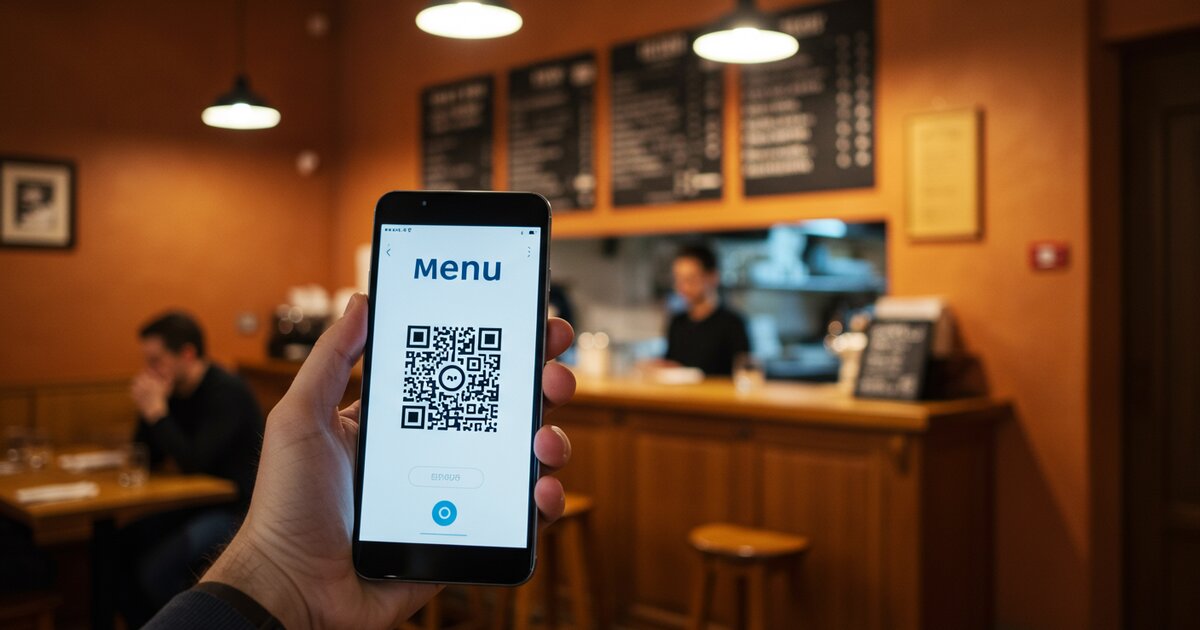
4. QR codes for in-venue digital menus
Since the pandemic, QR codes have become the norm. 58% of diners prefer a QR menu to a paper one according to a CHD Expert 2024 study (largely driven by hygiene perceptions).
Benefits of a QR menu:
- Instant updates (out-of-stock items, daily specials)
- Saves on paper and printing costs
- Multilingual capability (one tap = translated menu)
- Less physical handling
How to set it up:
- Generate a QR code linking to your online menu
- Print on table stands (acrylic tent cards or laminated inserts)
- Total cost: £15–£25 / $20–$30 for 10 tables
Common Mistakes to Avoid
❌ Mistake 1: Giving up after 2 weeks
Digitalisation isn't a sprint. Results take a minimum of 2–3 months to materialise, not 2 weeks.
Solution: Set quarterly goals rather than weekly ones.
❌ Mistake 2: Trying to be everywhere at once
There's no point being on 10 social platforms if you can't manage them. It's better to excel on 2 platforms than to be mediocre on 10.
Solution: Start with Google + 1 social network (Instagram OR Facebook), then expand when you have the capacity.
❌ Mistake 3: Poor-quality photos
A blurry or badly lit photo does more damage to your image than no photo at all.
Solution: Use a recent smartphone, favour natural lighting, and take 10 photos to keep only the best one.
❌ Mistake 4: Ignoring negative reviews
Not responding to a negative review lets the customer have the last word publicly. 73% of consumers believe a restaurant that doesn't reply to reviews doesn't care about its customers (BrightLocal).
Solution: Respond within 24 hours with professionalism.
❌ Mistake 5: Inconsistent information
Different addresses on Google and Facebook, outdated opening hours, wrong phone number… Every inconsistency loses customers AND hurts your search ranking.
Solution: Audit all your digital channels once a month (30 minutes).
Checklist: 7-Day Digitalisation Action Plan
Day 1: Online menu
- ✅ Choose a platform (free to start)
- ✅ Create your account
- ✅ Add your first 20 dishes
- ✅ Upload your logo and 3 photos
Day 2: Google Business Profile
- ✅ Claim your Google listing
- ✅ Complete 100% of your profile
- ✅ Add at least 10 photos
Day 3: Cross-channel consistency
- ✅ Verify NAP consistency (Google, Facebook, website, directories)
- ✅ Correct any errors found
Day 4: Online reputation
- ✅ Read all your current reviews
- ✅ Respond to 100% of them (start with the most recent)
- ✅ Create a QR code for Google Reviews
Day 5: Social media
- ✅ Create or optimise your professional Instagram account
- ✅ Post 3 dish photos with descriptions
- ✅ Set up Facebook Business (link to Instagram if possible)
Day 6: Optimisation
- ✅ Improve your dish descriptions
- ✅ Add allergens and vegetarian/vegan options
- ✅ Complete opening hours (including bank holidays)
Day 7: Launch and promotion
- ✅ Announce your digital menu to in-house customers (table sign or poster)
- ✅ Share the link on social media
- ✅ Send to your existing email list
Estimated total time: 8–12 hours over 7 days (1 to 2 hours per day)
Realistic Budget for a Small Restaurant
Level 1: Free (but effective)
- Online menu (free platform): £0/$0
- Google Business Profile: £0/$0
- Social media: £0/$0
- Total: £0/$0 per month
Level 2: Starter (£85–£130 / $100–$150 per month)
- Level 1 +
- Geo-targeted Facebook Ads: £70/$80 per month
- Reputation management or social media tool: £45/$50 per month
- Total: approx. £115/$130 per month
Level 3: Growth (£250–£350 / $300–$400 per month)
- Level 2 +
- Professional photographer (once per quarter): £175/$200 per quarter = approx. £58/$66 per month
- Premium booking software: £70/$80 per month
- Local Google Ads: £130/$150 per month
- Total: approx. £280/$326 per month
Recommendation: Start with Level 1 (free) for 3 months. If the results are promising, move to Level 2.
Real-World Data: What Actually Works
2025 industry study: digitalisation of small and independent restaurants
Profile of restaurants that successfully went digital:
- 67% started with zero budget (free tools only)
- 89% saw measurable results within 3 months
- 92% spend less than 30 minutes per day on digital upkeep
Average results after 6 months:
- +47% more new booking enquiries
- +34% more visibility on Google (impressions)
- Average Google rating went from 3.9 to 4.4 stars
- 28% reduction in time spent handling customer enquiries
Key success factors identified:
- Information consistency (NAP): #1 impact on local SEO
- Systematically responding to reviews: #1 impact on average rating
- Quality photography: #1 impact on click-through rate
Common barriers to digitalisation
Barriers cited by non-digitalised restaurateurs (2025 survey):
- 54%: "I don't have the time"
- 38%: "I don't know where to start"
- 31%: "I think it's too expensive"
- 27%: "I'm not comfortable with technology"
Reality after guided implementation:
- Actual time invested: 8–12 hours over 2 weeks (then 15–30 min/day)
- Actual cost to get started: £0/$0 (free tools are sufficient)
- Skills required: basic smartphone/computer use
Resources and Support
Public support programmes
Government digital support initiatives
- In the UK: Help to Grow: Digital (helptogrow.campaign.gov.uk)
- In the US: Small Business Administration (sba.gov) digital resources
- Free online diagnostic tools and sector-specific guides
Local Chambers of Commerce and trade associations
- Digitalisation workshops (often free or under £85/$100)
- One-to-one guidance
- Group training sessions
Hospitality trade bodies
- UKHospitality, the National Restaurant Association (US), or your local equivalent
- Free digital assessment tools
- Tailored training programmes
Free online training
Google Digital Garage
- "Fundamentals of Digital Marketing" course
- Free certification
- Modules specific to local businesses
Meta Blueprint (Facebook/Instagram)
- Training on managing business pages
- Local advertising
- Free and certified
Conclusion: You Don't Need a Huge Budget — Just a Method and Consistency
Digitalising a small restaurant is neither complex nor expensive. The industry data confirms it: 67% of digitalised restaurants started with zero budget, using free tools alone.
The 3 essential pillars:
- Online menu: Your digital shopfront, accessible 24/7
- Optimised Google presence: The gateway for 80% of searches
- Active reputation management: Your most powerful marketing lever
Realistic investment:
- Initial setup: 8–12 hours over 2 weeks
- Ongoing upkeep: 15–30 minutes per day (responding to reviews, occasional posts)
Minimum budget:
- £0/$0 to get started effectively
- £85–£130 / $100–$150 per month to accelerate growth
Next steps:
Digitalisation is a gradual process. Start with the fundamentals (online menu + Google + reputation management), measure results after 3 months, then refine your strategy.
The question is no longer "Should I go digital?" but "How do I optimise my visibility to capture the 90% of diners who search online?".
💡 Additional resources
To take your digital transformation further, several resources are available:
- Google Digital Garage (learndigital.withgoogle.com)
- Free guidance from your local Chamber of Commerce or trade body
- Meta Blueprint for Facebook and Instagram training
Solutions like ALaCarte.Direct let you create a professional online menu for free in just a few minutes.
Guide compiled based on BrightLocal 2025, CHD Expert 2024–2025, Google Business Profile 2025, and industry survey data.
Last updated: February 2026
3142 words