ALaCarte.Direct
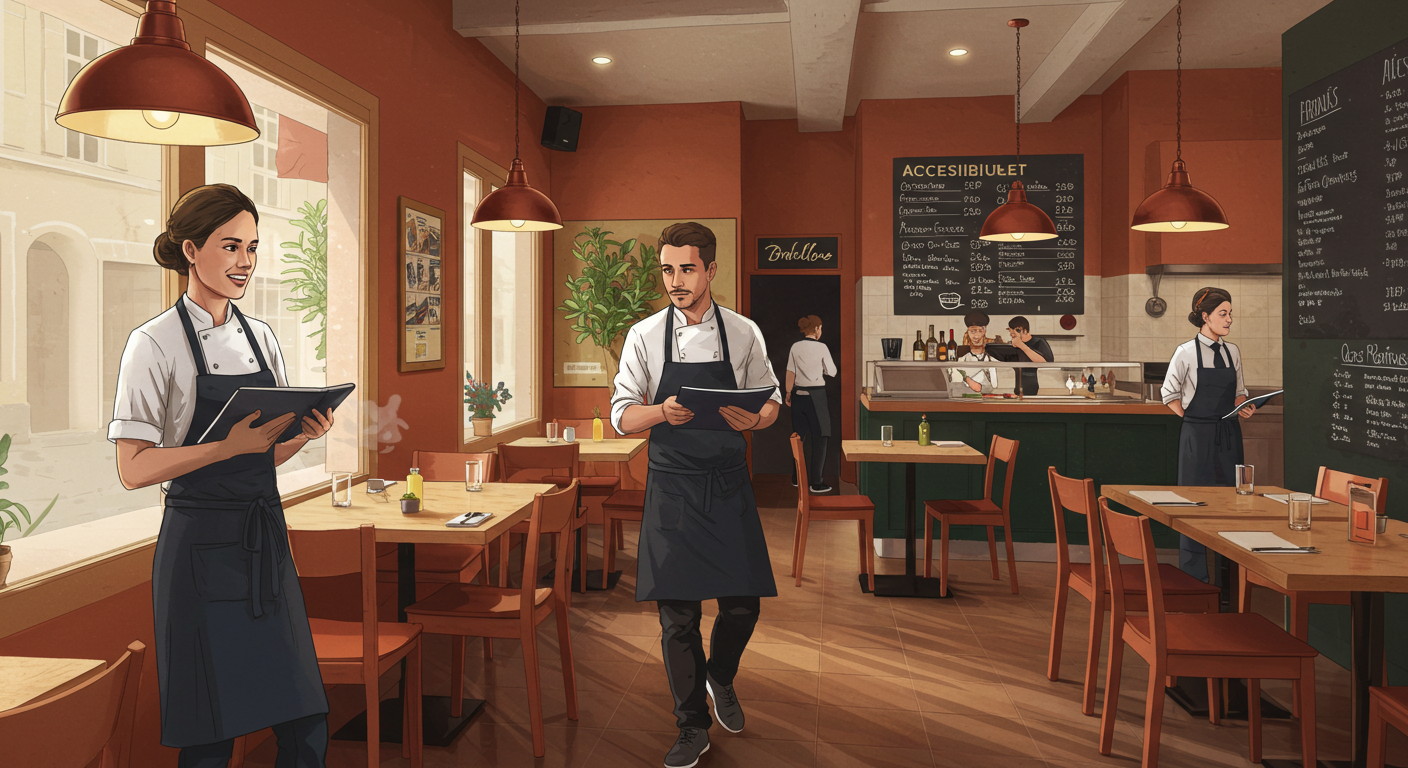
One in five restaurateurs only discovers their disability access obligations the day they receive a letter from the safety commission. By that point, urgent works cost two to three times more than if they had been planned ahead. Disability access in restaurants is not a side issue — it is a legal requirement for any establishment open to the public, and inspections have intensified in recent years. Whether you are opening a new restaurant or running an existing one, understanding and applying these standards protects you legally, broadens your customer base, and improves the experience for all your guests.
Here is everything you need to know to bring your restaurant into compliance with the accessibility standards in force in 2026.
Restaurant accessibility: what the law says for public establishments
The core legal framework
In France, the landmark law of 11 February 2005 on equal rights and opportunities established the founding principle: every establishment open to the public (known as an ERP — Établissement Recevant du Public) must be accessible to people with disabilities, regardless of the type of disability (motor, visual, hearing, cognitive, or mental health). Restaurants, classified as Type N public establishments, are directly affected.
This law has been supplemented by:
- The ordinance of 26 September 2014, which created the Programmed Accessibility Agendas (Ad'AP) — structured compliance timelines for businesses
- The decree of 17 May 2006, setting out detailed technical requirements
- The order of 8 December 2014, specifying compliance procedures
- The decree of 11 June 2021, strengthening the public accessibility register
In 2026, the Ad'AP compliance deadlines ended long ago. In other words, all public establishments are expected to be fully compliant. There are no further extensions: your restaurant must be accessible today.
The 5 categories of public establishments — and yours
Public establishments are classified into five categories based on their capacity:
- Category 1: over 1,500 people
- Category 2: 701 to 1,500 people
- Category 3: 301 to 700 people
- Category 4: up to 300 people (unless Category 5 applies)
- Category 5: below the thresholds set by safety regulations
The vast majority of independent restaurants fall into Category 5. This is important because the obligations differ slightly: Category 5 establishments must make at least part of the premises accessible, ensuring that people with disabilities can access all the services on offer.
In practical terms, if your restaurant has a ground-floor dining room and an upper floor, you are not required to make the upper floor accessible — provided the same services (same menu, same level of service) are available on the ground floor.
The penalties you face
Do not take this lightly. The penalties are real and enforced:
- Fine of €45,000 (approximately £38,000 / $48,000) for an individual who fails to comply with accessibility rules (Article L. 152-4 of the French Construction and Housing Code)
- Fine of €225,000 (approximately £190,000 / $240,000) for a company or legal entity
- Administrative closure of the establishment, ordered by the prefect
- Prison sentence of up to 6 months for repeat offenders
Beyond criminal penalties, you also risk civil liability claims from customers who were unable to access your premises. A single negative Google review mentioning an accessibility problem can also cause lasting damage to your reputation.
Restaurant accessibility standards: detailed technical requirements
External access and parking
Accessibility starts before customers even reach your front door. If your restaurant has a car park, at least one space must be reserved for disabled users for every 50 spaces. This space must be at least 3.30 m wide and located as close to the entrance as possible.
The path between the car park (or the public pavement) and the entrance must meet the following criteria:
- Minimum width: 1.40 m (1.20 m at occasional narrowing points)
- Maximum gradient: 5% (8% tolerated over 2 m, 10% over 0.50 m)
- Maximum cross-slope: 2%
- Surface: firm, non-slip, with no obstacle to wheels
- Marking: visual and tactile contrast at any change in level
If you have a terrace, the path from the pavement to the entrance must also be accessible. Pay particular attention to this if you set up terrace barriers or planters that could reduce the width of the passageway.
The restaurant entrance
The front door is often the first point of failure. Here are the rules:
- Minimum clear opening width: 0.90 m (main leaf) for new buildings; 0.80 m for existing premises with an exemption
- Manoeuvring space in front of the door: a rectangle of 1.70 m × 2.20 m on the opening side, to allow a wheelchair to manoeuvre
- Handle: easy to grip, at a height between 0.90 m and 1.30 m
- Opening force: less than 50 N (approximately 5 kg)
- Visual contrast: the door must be visually distinguishable from the façade
If your entrance has a step, you must install a permanent access ramp or, failing that, a removable ramp with a call system. Note: a removable ramp is a last-resort solution, not a matter of convenience. The safety commission will check that you genuinely could not install a fixed ramp.
Interior circulation
Once inside, a wheelchair user must be able to move freely to their table, the toilets, and the till.
Aisles and circulation:
- Minimum width: 1.20 m for main circulation routes
- Minimum width between tables: 0.90 m
- Turning space: a circle of 1.50 m diameter in every area where a customer needs to turn around
- Minimum headroom: 2.20 m under any obstacle
Table layout:
This is a point many restaurateurs overlook. You must provide at least one accessible table, meaning:
- Clearance under the tabletop: 0.70 m minimum (to allow knees and the wheelchair to fit underneath)
- No central pedestal base that would block approach
- A location that can be reached without asking staff to move other tables
In practice, reserve at least two accessible spots in your dining room, positioned to offer a genuine choice to the customer — not just a seat at the back near the toilets. Accessibility is also about dignity.
Accessible toilets
If your restaurant has customer toilets (which is mandatory for Type N public establishments), at least one cubicle must be accessible. Here are the required dimensions and fittings:
- Minimum dimensions: a manoeuvring space of 0.80 m × 1.30 m to the side of the bowl, plus a turning circle of 1.50 m diameter
- Bowl: seat height between 0.45 m and 0.50 m
- Grab bar: horizontal, beside the bowl, at a height between 0.70 m and 0.80 m, capable of supporting a force of 250 N
- Washbasin: wheelchair-accessible, with clearance underneath of at least 0.30 m deep and 0.60 m wide
- Taps: easy to operate (lever or infrared sensor), no twist-type taps
- Mirror: tilted or extending down to 1.05 m from the floor
- Lock: operable with one hand, unlockable from the outside in an emergency
- Door: opening outward or sliding, minimum width of 0.90 m
Fitting out an accessible toilet is often the most expensive item in a compliance project. Budget between €3,000 and €8,000 (approximately £2,500–£6,800 / $3,200–$8,500) depending on the scale of the work, based on estimates commonly reported by architects specialising in public establishments.
The counter and till
If you have a bar counter or a till:
- Part of the counter must be lowered to a maximum height of 0.80 m
- This section must be at least 0.60 m long
- Clearance underneath of 0.30 m deep, 0.60 m wide, and 0.70 m high must allow wheelchair approach
For the till, the payment terminal must be accessible: it should be tiltable towards the customer and at a height that can be operated from a wheelchair.
Restaurant disability obligations: beyond mobility impairments
Restaurant accessibility is not limited to wheelchair users. The regulations cover four categories of disability, and your obligations extend to each one.
Visual impairment
Customers who are partially sighted or blind must be able to find their way around and move through your establishment:
- Visual contrast: doors, steps, obstacles, and fittings must be visually contrasted against their surroundings (a minimum 70% contrast is recommended)
- Lighting: 100 lux minimum in interior circulation areas, 200 lux at reception points
- Tactile warning strips: at the top of every staircase
- Signage: contrasted characters, large size (15 mm minimum for proximity signage), positioned between 1.00 m and 1.60 m in height
And what about the menu? This is a crucial point. As a minimum, offer:
- A large-print menu (minimum 16-point font, high contrast)
- A digital version accessible on a smartphone, compatible with screen readers
On this point, a multilingual QR code menu for tourists has the added advantage of being compatible with assistive technologies — provided the digital menu is properly designed (semantic HTML tags, alt text on images).
Hearing impairment
Customers who are deaf or hard of hearing face difficulties in noisy environments — which describes most restaurants:
- Induction loop: mandatory in public establishments with a capacity of more than 50 people that have a PA system. For Category 5 restaurants without a PA system, it is not mandatory but recommended at the reception area
- Visual signage: any audible information must be duplicated visually (e.g. fire alarm with a flashing light)
- Acoustics: acoustic treatment to limit reverberation — a concern that also affects the comfort of all your customers
Train your staff to speak facing the customer (to enable lip-reading), to use written communication if needed, and to be patient.
Cognitive and mental health disabilities
These less visible disabilities affect a significant proportion of the population:
- Simple signage: clear pictograms, intuitive layout, no cluttered signage
- Staff training: knowing how to welcome someone who is disoriented or anxious, with kindness
- Simplified menu: a version of your menu with short descriptions and pictograms (allergens, dish type) makes things easier for everyone
Tracking analytics on your digital menu can also help you identify which dishes generate the most questions or hesitation, enabling you to simplify your offering for all audiences.
The public accessibility register: an often-forgotten obligation
Since 22 October 2017, all public establishments must make a public accessibility register available. It is a document that many restaurateurs simply do not know about.
What must this register contain?
- The certificate of compliance with accessibility rules or, failing that, the compliance timeline
- A list of administrative documents (opening permit, works authorisation, exemptions obtained)
- A description of staff training on welcoming people with disabilities
- Maintenance procedures for accessibility equipment
- For Category 1 to 4 establishments: a detailed note describing accessible services
How to set it up
The register can be a simple folder available at reception, or a PDF document viewable on a tablet. The French Ministry for Ecological Transition provides a free guide to help you compile the register, downloadable from the government website.
In practice, you can prepare this register in half a day:
- Gather your administrative documents (lease, safety commission report, any exemptions)
- Write a summary describing the accessible services in your establishment
- Document your staff training (even if informal)
- Place everything in a clearly labelled folder, available at reception
- Mention the existence of this register on your website
Exemptions: when and how to obtain them
The regulations provide three grounds for exemption for existing establishments. These exemptions are granted by the prefect, following advice from the departmental advisory commission for safety and accessibility (CCDSA).
The three legal grounds
-
Technical impossibility: the building's structure does not allow the work to be carried out (load-bearing walls, basement, listed building). You must provide a report from an architect or structural engineer demonstrating this impossibility.
-
Heritage preservation: your restaurant is in a listed or registered historic building, and the works would damage its heritage value. An opinion from the heritage architect (Architecte des Bâtiments de France) is then required.
-
Manifest disproportion between the cost of the works and the operator's financial resources, or between the cost and the impact on the business. This ground is assessed on a case-by-case basis. A 30-cover restaurant cannot be required to spend €80,000 (approx. £68,000 / $85,000) on works if its annual turnover is €200,000.
Compensatory measures
An exemption is never a blank cheque to do nothing. The prefect grants it subject to compensatory measures that guarantee access to services:
- Terrace service if the dining room is inaccessible
- Takeaway service if the entrance is inaccessible
- Staff trained to assist customers
- Provision of mobile equipment (removable ramp, magnifying glass, etc.)
Document these measures in your public accessibility register. They will be checked during inspections.
Budget and funding for restaurant accessibility works
Estimating the cost of your works
The cost of achieving compliance varies considerably depending on the initial condition of your premises and the scale of work required. Here are indicative ranges commonly seen in the sector:
- Fixed access ramp: €1,500 to €6,000 (£1,300–£5,100 / $1,600–$6,400) depending on length and material
- Removable ramp: €300 to €1,500 (£250–£1,300 / $320–$1,600)
- Door widening: €1,000 to €3,000 (£850–£2,550 / $1,060–$3,200)
- Full accessible toilet: €3,000 to €8,000 (£2,550–£6,800 / $3,200–$8,500)
- Tactile warning strip: €50 to €150 per linear metre
- Induction loop: €500 to €2,000 (£425–£1,700 / $530–$2,100)
- Counter lowering: €1,000 to €3,000 (£850–£2,550 / $1,060–$3,200)
- Accessible signage: €500 to €2,000 (£425–£1,700 / $530–$2,100)
For a Category 5 restaurant requiring standard compliance work (ramp, toilet, signage), the total budget typically ranges from €8,000 to €20,000 (approximately £6,800–£17,000 / $8,500–$21,000).
Available financial support
Several schemes can significantly reduce your investment:
- SME tax credit for accessibility expenditure: this covers a proportion of the costs incurred to make the premises accessible (subject to conditions — consult your accountant for current terms)
- Agefiph grants: if you employ staff with disabilities, the Agefiph (France's fund for the professional integration of disabled people) can co-fund certain adaptations
- Local grants: many municipal, departmental, and regional authorities offer specific funding. Contact your local chamber of commerce to find out about available schemes
- Subsidised loans from Bpifrance: as part of the modernisation programme for small and medium-sized businesses
To learn more about the overall financial management of your establishment, including mandatory insurance for your restaurant, factor these expenses into your annual cash flow plan.
Practical checklist: 20 points to check in your restaurant
Walk through this list putting yourself in the shoes of a wheelchair user, then a visually impaired customer, then a hearing-impaired customer. Tick off each point:
External access:
- The path from the public pavement is continuous and obstacle-free
- The gradient does not exceed 5% (or 8% over a maximum of 2 m)
- The surface is firm, non-slip, and free of holes
- A disabled parking space is available if you have a car park
Entrance:
- The front door provides a clear opening of at least 0.80 m
- There is no step, or a ramp is installed
- The door is easily identifiable (visual contrast)
- Sufficient manoeuvring space exists in front of and behind the door
Interior:
- Main aisles are at least 1.20 m wide
- A turning circle of 1.50 m exists in the dining room
- At least two tables are wheelchair-accessible
- The counter or till has a lowered section
Toilets:
- A compliant accessible toilet is available
- The door opens outward or is sliding
- Grab bars are installed and sturdy
- The washbasin is wheelchair-accessible
Signage and communication:
- The menu is available in large print or as an accessible digital version
- Lighting is adequate in all areas
- Staff are trained in welcoming people with disabilities
- The public accessibility register is available at reception
Print this list and walk around your establishment. Take photos of every non-compliant point: this will be your roadmap for the works.
Training your staff: the key to genuine accessibility
Building works and technical standards are only part of the picture. The human welcome makes all the difference between a restaurant that is "compliant on paper" and one that is truly welcoming.
Best practices to share with your team
General welcome:
- Speak directly to the person with a disability, not to their companion
- Offer help without imposing it: "Can I help you?" is enough
- Do not touch the wheelchair without asking permission
- Be patient and attentive
For customers with reduced mobility:
- Proactively offer an accessible, well-positioned table
- Clear the aisles if chairs or bags are in the way
- Offer to take their coat if the coat hook is too high
For visually impaired customers:
- Introduce yourself and briefly describe the space ("The table is on your right, the toilets are at the far end on the left")
- Read the menu aloud if the customer wishes
- Use the clock method to indicate positions on the table ("Your glass is at 2 o'clock")
For hearing-impaired customers:
- Speak facing the customer, at a normal pace, without exaggerating your articulation
- Use written communication if spoken conversation is difficult
- Reduce background noise if possible (lower the music nearby)
The training record
Include these training sessions in your public accessibility register. Even an in-house training session of one hour, documented with the date, content, and attendees, constitutes evidence of your commitment.
Several organisations offer short courses (half a day to a full day) designed specifically for the hospitality industry. Check with your sector training fund (in France, this is generally AKTO for the hospitality sector, via your OPCO): these courses may be fully funded.
Accessibility as a competitive advantage
Beyond legal compliance, accessibility is a genuine commercial lever that many restaurateurs underestimate.
A wider market
People with disabilities never come to a restaurant alone. They come with family, friends, and colleagues. A wheelchair user looking for an accessible restaurant for a dinner party of six will choose your establishment if you are compliant — and go to a competitor if you are not. It is the entire group you win or lose.
Similarly, charities and companies organising group meals that include people with disabilities will prioritise accessible venues. To develop this type of clientele, discover how to build partnerships with businesses for recurring events.
An ageing population
Accessibility also benefits elderly people with reduced mobility, parents with pushchairs, and people with temporary disabilities (a broken leg, crutches). With the ageing population, the number of people who need an accessible environment will only increase in the years ahead.
Online visibility
Several booking platforms and directories now list the accessibility features of restaurants. Google Maps allows businesses to indicate wheelchair accessibility. A restaurant marked as accessible appears in filtered search results — a significant local SEO advantage.
You can also highlight your accessibility on your own website and digital menu. With a tool like ALaCarte.direct, for example, you can add an accessibility notice directly on your online menu, visible to all customers before they even visit.
Positive word of mouth
People with disabilities actively share good addresses with each other. Being recognised as an accessible and welcoming restaurant generates powerful word of mouth within a close-knit community. A referral programme can amplify this natural dynamic by rewarding customers who recommend your establishment.
Compliance timeline: your action plan
If your restaurant is not yet fully compliant, here is a realistic three-month action plan:
Weeks 1–2: Diagnosis
- Work through the checklist above and identify non-compliant areas
- Take photos and list the works required
- Contact an accessibility assessor or a specialist architect
Weeks 3–4: Costing and funding
- Obtain at least two quotes for the works identified
- Research available grants and funding through your local chamber of commerce
- Consult your accountant about the tax credit
Month 2: Priority works and immediate measures
- Start with low-cost, high-impact works: signage, removable ramp, counter lowering
- Set up your public accessibility register
- Train your staff (a one-hour session is enough to get started)
Month 3: Structural works and finalisation
- Carry out the heavier works (toilets, door widening)
- If certain works are impossible, submit an exemption request to the prefecture
- Update your Google Maps listing and website to indicate your accessibility
- Do a final walkthrough with the full checklist
Conclusion: take action this week
Making your restaurant accessible is not a project to put off. The standards are in force, inspections happen, and the penalties are severe. But beyond legal obligation, making your restaurant accessible means welcoming all your customers with the same quality of service.
Three actions to take this week:
- Walk through your restaurant with the checklist in this article. Identify your weak points in 30 minutes.
- Create your public accessibility register if you do not have one. It is half a day of administrative work.
- Brief your team on best practices for welcoming guests with disabilities. Fifteen minutes during your next pre-service briefing can make all the difference.
Perfect accessibility does not exist, but every improvement counts. A restaurant that shows willing, trains its staff, and makes steady progress will always be viewed more favourably — by customers and inspectors alike — than one that ignores the issue. Start today, take it step by step, and make your restaurant a place where everyone feels welcome.