ALaCarte.Direct
Displaying allergen information has been a legal requirement for all restaurants since 2014 — yet 21% of establishments were still found non-compliant in 2026. This comprehensive guide explains what you need to display, how to do it, and how going digital makes compliance radically simpler.
1. The Regulatory Framework: EU INCO and National Legislation
Allergen labelling regulations are built on two key pieces of legislation:
- EU Regulation No 1169/2011 (INCO)
- Governs the provision of food information to consumers. Applicable since 13 December 2014 across the entire European Union. Requires information on 14 allergens for all pre-packed foods AND non-pre-packed foods (including restaurant meals).
- French Decree No 2015-447
- Sets out the specific rules for applying INCO in French food service. Allows oral or written allergen information for non-pre-packed foods, but requires that the information be accessible, accurate, and available on request.
- Order of 25 November 2011
- Establishes the list of 14 allergenic substances that must be declared.
- DGCCRF Guidance 2024
- Practical guidelines for the food service sector. Recommends written, permanent display (on the menu or alongside it) to prevent any disputes.
2. The 14 Mandatory Allergens
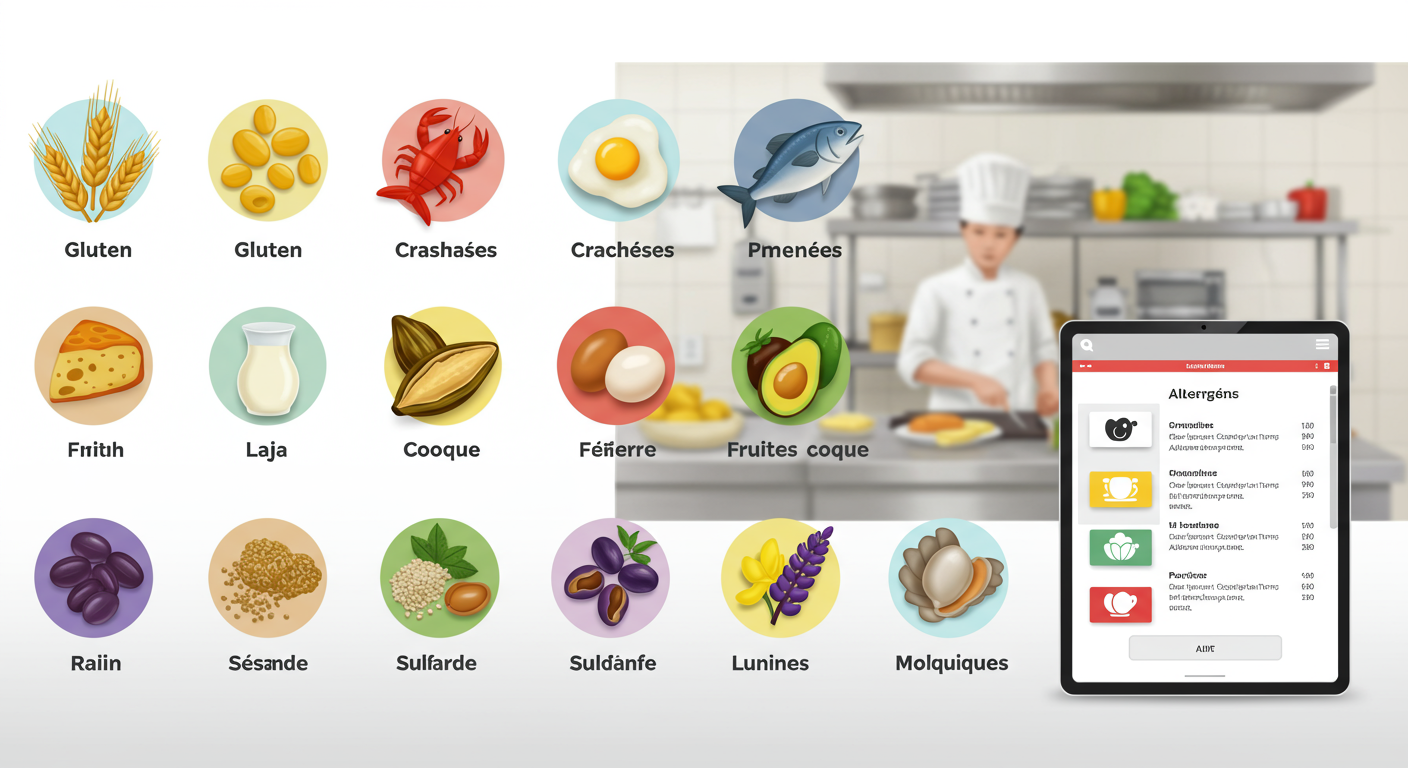
These 14 substances must be declared whenever they are used in a dish, even in trace amounts:
| # | Allergen | Common examples |
|---|---|---|
| 1 | Cereals containing gluten | Wheat, rye, barley, oats, spelt |
| 2 | Crustaceans | Prawns, lobster, crab, langoustine |
| 3 | Eggs | Hen's eggs and other poultry eggs |
| 4 | Fish | All fish, including anchovies |
| 5 | Peanuts | Peanut butter, groundnut oil |
| 6 | Soya | Soya lecithin, tofu, miso |
| 7 | Milk | Butter, cream, cheese, lactose |
| # | Allergen | Common examples |
|---|---|---|
| 8 | Tree nuts | Walnuts, hazelnuts, almonds, pistachios, cashews |
| 9 | Celery | Celeriac, celery stalks, celery salt |
| 10 | Mustard | Mustard seeds, leaves, mustard oil |
| 11 | Sesame seeds | Tahini, sesame oil, sesame bread |
| 12 | Sulphur dioxide / Sulphites | Wines, vinegars, dried fruits (>10mg/kg) |
| 13 | Lupin | Lupin flour, lupin seeds |
| 14 | Molluscs | Mussels, oysters, squid, snails |
3. Your Specific Obligations by Type of Establishment
Table-service restaurants
- ✅ Written allergen information on the menu, the carte, or a notice available to customers
- ✅ Information available before ordering (not only upon verbal request)
- ✅ Information that is accurate and up to date whenever recipes or suppliers change
- ❌ Verbal-only disclosure ("ask your server") is no longer considered best practice — regulators recommend written display
Takeaway / click & collect restaurants
- ✅ Allergen information displayed on the online menu before the order is placed
- ✅ Information on the packaging or on a document included with the order
- ✅ For delivery platforms (Uber Eats, Deliveroo, Just Eat): ensure allergens are properly listed on your platform profile
Buffets and self-service
- ✅ Individual labels on every dish
- ✅ A summary chart that is visible and accessible
Hotels (room service, in-house restaurant)
- ✅ In-room menu with allergen information
- ✅ Website or app with allergens listed if digital ordering is available
- ✅ Staff trained to respond to guest enquiries about allergens
4. Risks and Penalties for Non-Compliance
Food safety authorities carry out unannounced inspections. In 2025, 21% of restaurants inspected in France received formal notices for allergen non-compliance.
Fines of up to €1,500 (approx. £1,300 / $1,700) per offence. Repeated violations can result in enforced closure of the premises.
If a customer suffers harm due to an undeclared allergen, the restaurant owner can be held personally liable. Courts have handed down damages running into tens of thousands of euros.
"Food safety authorities have stepped up allergen inspections since 2024. Restaurants that fail to display allergen information clearly face penalties — but more importantly, they put their customers at serious health risk."
5. How to Display Allergens: 4 Methods Compared
| Method | Cost | Updates | Legal compliance | Recommended |
|---|---|---|---|---|
| Paper allergen chart A printed chart displayed in the dining area with ✓/✗ per dish |
~£15 / $20 (printing) | ⚠️ Must reprint with every change | ✅ Compliant | 🟡 Acceptable |
| Printed on the menu Symbols or icons next to each dish |
~£40–80 / $50–100 (design + printing) | ⚠️ Reprinting required | ✅ Compliant | 🟡 Acceptable |
| Allergen folder/binder Detailed folder available on request |
~£25 / $30 (laminating) | ⚠️ Tedious manual updates | ⚠️ Compliant if readily accessible | 🔴 Not recommended (frequent source of disputes) |
| Digital menu with built-in allergens Icons per dish, real-time updates |
£0 / $0 (free solutions available) | ✅ Instant updates | ✅ Compliant + digital audit trail | ✅ Recommended |
6. Digital Menus: The Simplest and Safest Solution
A digital menu solves all allergen compliance challenges in one go:
- Automatic allergen icons on every dish
- Instant updates with no reprinting
- Change history (proof in case of inspection)
- Filters for allergy sufferers (improved customer experience)
- Multilingual: allergens displayed in your customer's language
- Fewer questions for your waiting staff → smoother service
- Allergy-conscious customers feel safer → stronger loyalty
- Zero printing or laminating costs
- Automatic compliance whenever you update your menu
- Enhances your reputation ("responsible restaurant")
How it works with ALaCarte.Direct
- Create your menu on alacarte.direct (free, takes 30 seconds)
- For each dish, tick the relevant allergens from the list of 14
- Automatically, allergen icons appear on your digital menu
- Your customers can filter by allergen straight from their smartphone
- Changed a recipe? One click is all it takes to update the display
7. Allergen Compliance Checklist 2026
Initial mise en place (one-time setup)
Ongoing maintenance (with every change)
Official Resources
- DGCCRF — Practical guide to allergens in food service (France)
- EU Regulation 1169/2011 (INCO) on Légifrance
- UMIH — France's leading hospitality trade association
- GNI — National association for independent hotels and restaurants (France)
ALaCarte.Direct has built-in management of all 14 allergens in your digital menu — completely free. Get started in 30 seconds →